
 ΔΕΙΤΕ ΠΡΩΤΟΙ ΟΛΑ ΤΑ ΝΕΑ ΤΟΥ TRIBUNE ΣΤΟ GOOGLE NEWS
In the heart of Greek journalism, the Union of Journalists of Daily Newspapers of Athens (ESIEA) hosted a significant event on Wednesday, December 3, 2025. Organized by the “Nikos Kapetanidis” Action Association, the topic of the discussion was: “The Rhetoric of Denial and the Persecution of Journalists by Turkey.” The speakers, offering documented and academic analyses, highlighted an issue that has become a dominant ideology and a perennial taboo for Ankara.
In the heart of Greek journalism, at the headquarters of the Union of Journalists of Daily Newspapers of Athens, the Action Association “Nikos Kapetanidis” hosted an event on Wednesday, December 3, 2025, titled: “The Rhetoric of Denial and the Persecutions of Journalists by Turkey.”
The speakers delivered well-documented and scholarly presentations, spotlighting an issue that has become a dominant ideology and enduring taboo for Ankara.
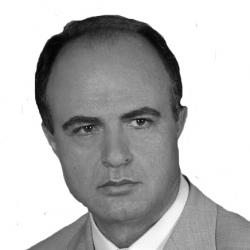
◾Geopolitical analyst and author Savvas Kalenteridis focused on the assassination of Armenian-origin journalist Hrant Dink, emphasizing that the Genocide of Greeks, Armenians, and Assyrians remains a matter of survival for Turkey—which is why it categorically denies historical facts and launches international interventions to block recognitions.
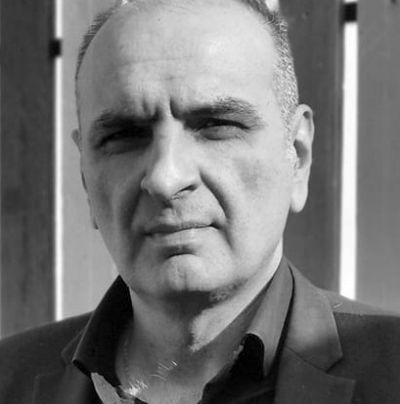
◾Journalist and analyst Stephanos Mytilineos [Stefanos Mytilinaios] discussed the Erdogan regime’s grip on the media, which stifles dissenting voices, allowing only self-exiled journalists in Western countries to bring the truth to light.
◾Historian and genocide specialist Dr. Vasileios Meichanetsidis offered a deeper scientific examination of the Genocide, illuminating lesser-known aspects—such as how Raphael Lemkin, in coining the term “Genocide,” studied the ethnic cleansings of Greeks and Armenians that preceded the Jewish Holocaust.
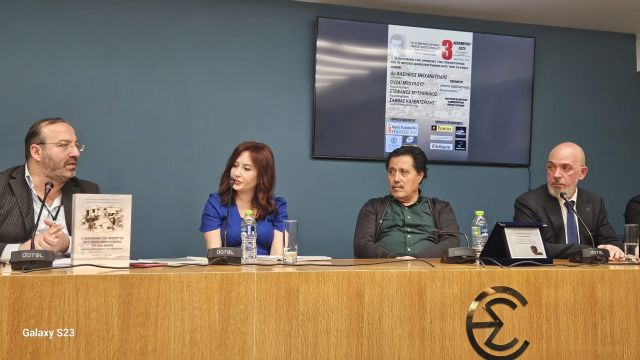
Vassilios Meichanetsidis, Savvas Kalenteridis, and Stephanos Mytilineos (from left in the photograph) spoke about Uzay Bulut’s significant contribution to press freedom and historical truth.
The speech delivered by Trabzon-born journalist Uzay Bulut was compelling and moving.
Bulut detailed the systematic, state-sponsored brainwashing in Turkey that has created generations who blindly deny the genocide of Christians.
She revealed that the genocide was executed under the pretense of Holy War—a Jihad committed solely by Muslims, with no participation from subjugated non-Muslims.
Furthermore, she urged the academic community, particularly in Greece, to conduct more extensive research to better illuminate the Genocide and to expose the denial tactics and the targeting of those who study and recognize it.
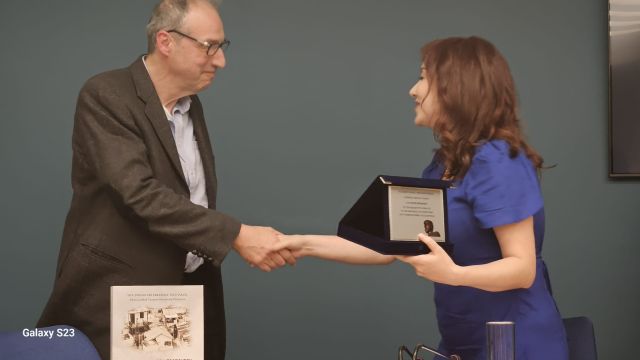
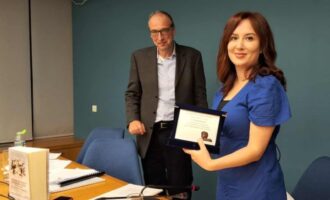
The evening concluded with a moving tribute. Costas Kapetanidis, the grandson of the National Martyr Nikos Kapetanidis’s brother and Vice-President of the association, presented Ms. Bulut with an honorary plaque.
The award recognized her unwavering fight for genocide recognition and her commitment to journalistic integrity.
The event was held by the “Nikos Kapetanidis Action Association” in observance of December 9, the UN International Day of Commemoration and Dignity of the Victims of the Crime of Genocide and of the Prevention of this Crime.
It serves as another critical link in the ongoing effort to highlight history, defend memory, and inform public opinion on issues concerning human rights and press freedom.
Next Event in Thessaloniki
The next event is scheduled for Monday, December 8, 2025, at 6:00 PM at the conference center of the Journalists’ Union of Macedonia and Thrace (ΕΣΗΕΜΘ), located at 5 Stratigou Kallari Street (where the bust of National Martyr Nikos Kapetanidis is situated). The theme will be:
“Turkey’s Denial of the Genocide and the Targeting of Journalists and Activists by the Perpetrator Turkey – The Example of Uzay Bulut.”
Admission is free.
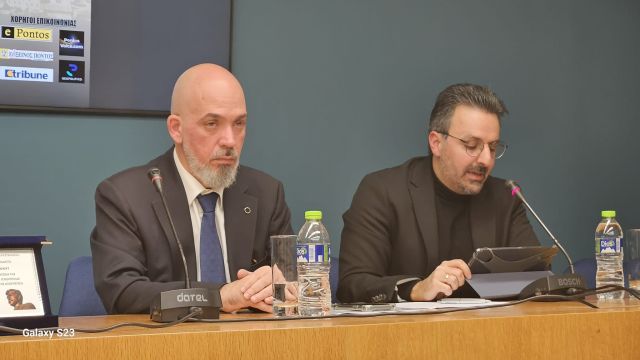
Stephanos Mytilineos (left), diplomatic correspondent for the news website Tribune.gr, and journalist Christos Constantinidis, one of the event organizers and an executive of the action association.
The Speech of Diplomatic Correspondent Stephanos Mytilineos at JUADN on Uzay Bulut:
“Today is a special event. An event of great honour and historical memory, which takes place in this revered space of the Freedom of the Press, of Free Thought, and of the Unsubmissive Conscience, at the Journalists’ Union of Athens (ESIEA).
“Initially, I must thank the organizers: The ‘Nikos Kapetanidis’ Action Society, which took the initiative for the present event and proudly bears the name of the democrat, patriot, enlightener, and Ethnomartyr Pontian journalist Nikos Kapetanidis, who was hanged by intolerant Kemalism in 1921.
“The journalist Nikos Kapetanidis, the unyielding champion of national independence, dignity, social justice, the vernacular language (demotic), and the secular education of Greek children, freed from the bonds of obscurantism and the Turcophile theocracy.
“The man who offered his thought and his pen to the sacred altar of the homeland. The Greece of values, not Greece as a geographical designation, but Greece as a system of values. Because Greece is not simply a place; Greece is, above all, an idea.
“And Greece has no other borders than those determined by its five-thousand-year history and its civilisation.
“As the philosopher Plutarch wrote in his work, On Exile, 600F—the first treatise, if you will, on refugees two millennia ago: ‘“Man, as Plato says, ‘is not a plant of the earth’ nor an immobile thing, ‘but a celestial one,’ where the head, like another root, holds the body upright, turned toward the sky. Therefore,’—Plutarch continues—’Heracles rightly said: ‘Argive or Theban, since I boast not that I belong to a single city; all the strongholds of the Greeks are a homeland to me.’”
“This paragraph, I believe, must be our perpetual compass. Nikos Kapetanidis is one of the hundreds of thousands of Greeks—some estimate more than a million of our Greek ancestors in Asia Minor—who were massacred more than a century ago—under German guidance—by the Ottomans and the so-called Turks.
“The genocide of the Greeks of Pontus and of Asia Minor as a whole is an undisputed fact. The neighbours deny it, and so do some domestic elements. As for the domestic ‘useful idiots,’ I believe only contempt and aversion are fitting for them.
“All those who shamelessly reproduce—like latter-day ‘Nenekos,’ like fifth-columnists—the propaganda of the ethno-Islamist and neo-Ottoman imperialist regime in Ankara, under the pretext of some falsely labelled leftism and neoliberalism, allegedly in the name of peace and the friendship of peoples.
“In reality, they are mouthpieces for the proven deception—or if you prefer, fraud—of the so-called Greco-Turkish friendship, which is nothing but a capitulation.
“We will never capitulate. And there can be no peace and friendship founded on historical oblivion. There can be no peace without truth and justice. Justice for our dead, justice for the rivers of innocent blood that were spilled.
“Those Greeks of Pontus, the ‘lucky’ ones amid the disaster, who took refuge as refugees in the free territories of the Greek state and prospered living among mainland Greeks, always remind us that their home is not here. It is across the sea.
“They should have been living, creating, and prospering there. On the shores of the Black Sea, in their ancient cities and villages, from where they were violently expelled—those who were not massacred or Turkified through forced Islamisation. This latter was the price to remain on their land.
“And of course, we do not forget the hundreds of thousands of surviving Greeks in Russia and Ukraine. Those whom the corrupted mainland Greek state calls Russo-Pontians. Those who did not return to Greece after the collapse of the ‘paradise’ still live today on the northern shores of the Black Sea, in Russia, Ukraine, and the Caucasus.
“These Greeks, although rescued from the slaughter unleashed by the Asians, later experienced their own hardships and deportations by their Russian-Soviet alleged ‘saviours.’ The Greeks of Pontus have paid the heaviest toll in blood to the hordes of the steppe. From a maniacal hatred that they did not provoke.
“I mentioned earlier that many thousands of Greeks of Pontus remained on their ancestral lands by becoming Islamized and subsequently Turkified. Many maintained the Greek language as a local dialect. They call it ‘Romeika.’
“It should be noted that many maintained a Greek consciousness as crypto-Greeks and the Christian religion as crypto-Christians. Much has been written about these people. Books, articles, reports, all documented. Personally, I have met Greek Muslims from Pontus.
“However, I must invoke an admission by Michalis Chrysochoidis many years ago, when he was still with PASOK, on a television show, where he spoke of 2 million Turkish citizens of Greek descent in Pontus. However, I consider a statement by the controversial Imam Imamoglu more interesting, made seven years ago to the Cyprus News Agency, specifically in April 2019, in which he stated:
“‘There are villages and families in the Black Sea who speak “Romeika.” But my village or my family does not speak “Romeika.” There is an ethnic language in the Black Sea and this ethnic language is still spoken. For example, in Trabzon, it exists in some neighbourhoods. But not in my village, which is why I don’t know it. If I knew, I would be speaking to you now, but I don’t know,’ he said, explaining that in the region ‘a language is spoken, they don’t exactly call it Greek; the people call it “Romeika.” But we, as a family, don’t know it.’
“But what could be greater evidence than the living proof? Especially when I have beside me our colleague, Uzay Bulut, from Trabzon. I first learned about Uzay Bulut, who stands before you, many years ago through her journalism. Through her articles online.
“And I won’t hide that she immediately caught my attention with her frankness (parrhesia). A Turkish journalist writing against the suffocating control of the prevailing line.
“You know, and if you don’t, I’m telling you, 90% of the Media in Turkey are controlled by the Erdoğan regime. Only a few journalists, either self-exiled in Western countries or of Kurdish origin, write the other perspective. The other news.
“Hundreds of my colleagues are rotting in Turkish prisons, usually accused of spreading ‘terrorism.’ Daily, as I am informed mainly by Kurdish media, journalists are arrested.
“There is no freedom of the press in Turkey. There is no democracy in Turkey, only an ethno-Islamist regime that is methodically paving the way for the imposition of an ethno-Islamist, neo-Ottoman theocracy of the Muslim Brotherhood.
“The revival of the Caliphate, with Erdoğan as Caliph forever, modelled on the Iranian Islamist theocracy, is the one-way street that the Ankara regime is implementing. We Greeks know it well, the Kurds are experiencing it harshly, and the Israelis are confronting it dynamically.
“I had the honour of meeting Uzay Bulut in person when she came to Greece. I was perhaps one of the first mainland Greeks to meet her. And from the beginning, I admired her courage and bravery (palikaria).
“I admired her journalism, which I consider—because she also writes in English, thus reaching broader audiences—far more beneficial than domestic diplomatic reporting that stays among ourselves.
“I will not judge my Greek colleagues in diplomatic reporting, but I cannot help but comment that it would be a blessing if they had offered as much in the defense of truth as Uzay Bulut has.
“Therefore, it was no surprise to me when, months ago, Uzay Bulut publicly revealed her Greek descent while being a guest on an online show. It was rather expected. Of course, I don’t hide that I was also surprised.
“Knowing well that our colleague already faces an unscrupulous system that persecutes her because of her journalism. And even today, as I have her next to me, I still wonder where she draws her strength and chivalry (leventia) from.
“The answer is probably simple. She draws it from her soul and her conscience.
“Uzay Bulut is an example for all of us, and I think any more words are superfluous. Her work and her life prove the difficult path she unyieldingly chose to follow.
“For this reason, we honour her today in the most humble yet sincere way.”