 ΔΕΙΤΕ ΠΡΩΤΟΙ ΟΛΑ ΤΑ ΝΕΑ ΤΟΥ TRIBUNE ΣΤΟ GOOGLE NEWS

(…)
Afrique dis-moi Afrique
Est-ce donc toi ce dos qui se courbe
Et se couche sous le poids de l’humilité
Ce dos tremblant à zébrures rouges
Qui dit oui au fouet sur les routes de midi
(…)
David Diop, «Afrique mon Afrique»
The Expansion of the Moscow Patriarchate in Africa, the Clash with the Patriarchate of Alexandria, and the Emergence of a New Form of Russian Influence on the Black Continent
The Russian presence in Africa (like any other presence originating outside Africa) is neither an act of altruism nor nostalgia for the Soviet era. It is a coldly calculated geopolitical strategy.
Moscow seeks to gain access to strategic ports, valuable raw materials, and political allies that will strengthen its international standing against the West.
With weapons, military advisers, and security agreements, Russia is penetrating countries where European and American influence is receding.
Where the West often ties its aid to conditions regarding democracy and human rights as it defines them, Moscow offers support without political preconditions, securing valuable returns in mining, energy projects, and military facilities.
Africa, therefore, is not merely an emerging market for Russia. It is a critical front in the global competition for power, where Moscow is attempting to prove that it remains a global power capable of projecting influence far beyond its borders.
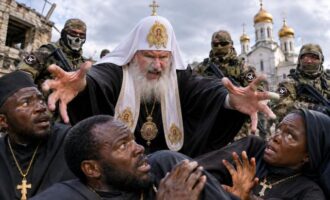
The establishment of the Patriarchal Exarchate of Africa by the Moscow Patriarchate in December 2021 was perhaps the most radical and controversial ecclesiastical initiative in the modern history of Orthodoxy.
It appeared as a response to the recognition of the autocephaly of the Orthodox Church of Ukraine by Patriarch Theodore II of Alexandria, yet it soon became clear that the stakes far exceeded the Ukrainian issue.
The investigation by independent journalist Ivan Makrindin in Novaya Gazeta, based on field missions in Kenya, dozens of interviews, and years of monitoring the Exarchate’s activities, reveals a far more complex reality.
Behind the ecclesiastical rhetoric of defending “canonicity” lies a broad network of political, economic, and strategic interests, within which the Russian Church operates as one of the primary vehicles of the Russian presence in Africa.
The First Open Challenge to the Patriarchate of Alexandria
The significance of the Exarchate’s establishment cannot be understood without reference to the special position of the Patriarchate of Alexandria within Orthodox tradition.
Since the early Christian centuries, the African continent has been considered the exclusive canonical territory of the Patriarchate founded, according to tradition, by Mark the Evangelist. This principle was recognized even by the Moscow Patriarchate itself until 2021.
The Russian decision did not constitute a mere administrative intervention.
For the first time, an Orthodox Church systematically established a parallel ecclesiastical structure within the territory of another Patriarchate.
For this reason, many ecclesiologists saw in the African Exarchate something far beyond a protest over Ukraine.
They discerned the emergence of a new conception of ecclesiastical power, according to which traditional geographical boundaries can give way to ideological, political, or economic expediencies.
Africa as the New Field of Russian “Ecclesiastical Internationalism”
Makrindin’s investigation reveals a second important element.
Moscow is no longer limiting itself to caring for the Russian diaspora or former Soviet regions.
On the contrary, it is attempting to create indigenous ecclesiastical communities directly linked to the Russian Church.
Kenya is the most characteristic example. There, Orthodoxy already had deep roots thanks to the work of the Patriarchate of Alexandria and Greek missionaries. There were churches, schools, organized communities, and hundreds of clergy.
Moscow, therefore, found an already established ecclesiastical environment.
The goal was not to create new parishes, but to attract existing clergy.
This explains why the first major effort focused on approaching African priests belonging to the Patriarchate of Alexandria rather than establishing new missions.
The Economics of the Mission
One of the most revealing aspects of the interview concerns the economic factor.
Most African Orthodox communities operate under extremely difficult conditions. Clergy often support families with minimal resources, while local Churches are unable to cover basic needs.
The Russian Church capitalized on this exact reality.
The salaries it offered were not spectacular by European standards, yet they were significantly higher than what many African priests were receiving.
At the same time, orphanages, local agricultural activities, educational programs, and social structures were funded.
This case demonstrates that in Africa, ecclesiastical influence is not decided solely at theological conferences or in synodal decisions.
It is often decided by a Church’s ability to provide practical support to communities facing severe survival challenges.
George Maximov and the “Diplomacy of Missionaries”
A prominent place in the investigation is occupied by missionary Archpriest George Maximov.
Long before the Exarchate was created, Maximov toured various African countries meeting with clergy of the Patriarchate of Alexandria.
He built personal relationships, discussed the problems of local communities, and presented the Russian position on Ukraine.
According to testimonies gathered by Makrindin, Maximov was perhaps the most important figure in the undertaking.
He acted not merely as a missionary, but as a liaison between Moscow and the African clergy.
Through his activities, the first networks were formed that later became the core of the Exarchate.
The Church as a Tool of Soft Power
Perhaps the most substantive conclusion of the investigation is that the Russian Church operates as a “soft power” mechanism of the Russian state.
The term does not imply that the Church is administratively controlled by state agencies.
However, it describes its ability to generate cultural and social influence in regions where a military or political presence would be harder to accept.
Priests and bishops come into contact with local leaders, educational institutions, social organizations, and political actors.
They build relationships of trust and communication networks that often prove valuable for Russia’s overall presence.
It is no coincidence that in countries such as Tanzania or Equatorial Guinea, ecclesiastical activity is developing alongside the expansion of Russian state enterprises, particularly Rosatom.
The Shadow of Wagner and the “Africa Corps”
The interview also touches upon an issue of particular interest: the relations between the Russian Church and Russian military structures in Africa.
Despite the absence of direct evidence of organized cooperation with Wagner, the investigation shows that the ecclesiastical presence developed more easily in regions where strong Russian military influence already existed.
Particularly in the Central African Republic, several of the journalist’s interlocutors linked the Exarchate’s success to the broader network of Russian actors operating in the country.
Following the reorganization of Russian military presences under the “Africa Corps,” these relations are now displayed far more openly than in the past.
The Future of an Ecclesiastical Confrontation
Four years after the founding of the Exarchate, the outcome of the confrontation remains uncertain.
The Patriarchate of Alexandria continues to maintain a much broader presence on the continent and deeper historical roots.
However, the Russian initiative has managed to disrupt balances that seemed immovable.
Above all, it has revealed that Africa has become one of the most important arenas of the modern Orthodox world.
It is now a place where not only different ecclesiastical conceptions meet, but also competing geopolitical strategies.
The African Exarchate is not merely another ecclesiastical province of the Russian Church.
It constitutes the most characteristic example of the new era into which Orthodoxy is entering—an era in which religion, politics, economics, and international power interact ever more closely, blurring the boundaries between pastoral mission and geopolitical strategy.