
 ΔΕΙΤΕ ΠΡΩΤΟΙ ΟΛΑ ΤΑ ΝΕΑ ΤΟΥ TRIBUNE ΣΤΟ GOOGLE NEWS
In a post by the Turkish Ministry of Foreign Affairs, it is claimed that the Greek-speaking Muslim population of the Peloponnese, which it refers to as “Turkish,” suffered systematic massacres during the period of the Greek Revolution 1821–1830.
At the same time, the Turkish Ministry of Foreign Affairs claims that the policy of extermination was accompanied by a deliberate campaign of destruction and desolation, which affected places of worship, madrasas, cemeteries, and other cultural heritage monuments.
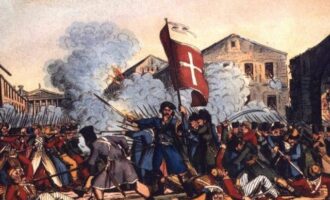
Concluding, on the occasion of the 205th anniversary of the events of Tripolitsa (The Fall of Tripolitsa took place on September 23, 1821), the Turkish Ministry expresses a tribute of respect, with prayers and reverence, to the Muslim “Turkish” civilians who, according to the statement, were violently murdered.
The provocative post by the Turkish Ministry of Foreign Affairs – Specifically, the Turkish Ministry of Foreign Affairs stated in its post:
“The Muslim Turkish population of the Morea (Peloponnese) Peninsula was systematically massacred between the years 1821 and 1830.
A calculated campaign of destruction and devastation accompanied this policy of extermination, extending from places of worship and madrasas to cemeteries and other assets of cultural heritage.
On the 205th anniversary of the Tripolitsa Massacre, we commemorate with prayers and deep respect the Muslim Turkish civilians who were brutally murdered.”
The Muslim Turkish population of the Morea (Peloponnese) Peninsula was systematically massacred between the years 1821 and 1830.
A calculated campaign of destruction and devastation accompanied this policy of extermination, extending from places of worship and madrasas to… pic.twitter.com/cYUV5fzXUT
— Turkish MFA (@MFATurkiye) September 23, 2026
The historical truth:
They were Greek Μuslims in Tripolitsa and not Turks
The position that the Muslims of the Peloponnese (and specifically of Tripolitsa) were, in their overwhelming majority, local Greek-speaking populations (converts to Islam) and not ethnically Turks from Anatolia is extensively recorded in historiography.
In the Ottoman Empire, identity was determined by the religious system (millet).
All Muslims were collectively referred to as “Turks” by Christians, regardless of their ethnic origin or the language they spoke.
Historical sources and references:
François Pouqueville – Voyage de la Grèce (1820–1821): The French traveler, diplomat, and consul of France to Ali Pasha and the Morea notes in his travel records that the Muslims of the Peloponnese (the so-called “Moraites” or “Moralides”) were mostly descendants of local Christians who had converted to Islam during previous centuries.
He specifically mentions that their mother tongue was Greek and that very few knew the Turkish language, which was used almost exclusively by appointed Ottoman officials.
Michail Oikonomou – History of the Greek Regeneration (1873): The secretary of Theodoros Kolokotronis and an eyewitness to the events in the Peloponnese states that the local Muslims of Arcadia and the Morea spoke the Greek language, used it in negotiations among themselves during the siege of Tripolitsa, and shared the same customs and traditions as their Christian compatriots.
William St. Clair – That Greece Might Still Be Free (1972): The British historian analyzes the population composition of the Peloponnese prior to 1821, pointing out that the “Turks of Morea” were in reality Greek-speaking Muslims whose ancestors had converted to retain their land and privileges, while the presence of ethnic Turks (originating from Asia) was limited to the city’s administrative and military elite.
Apostolos Vakalopoulos – History of Modern Hellenism: The historian documents the existence of compact non-Christian but Greek-speaking groups in the Peloponnese (such as the Muslims of Lala in Elis, of Bardounochoria in Laconia, and of Tripolitsa).
He emphasizes that the conversion of local populations to Islam from the 15th to the 18th century was the main factor shaping the Muslim community of the Morea.
Composition of the Muslim population in Tripolitsa (1821):
The population of Muslims present in Tripolitsa during the siege was divided into the following categories:
Greek-speaking Moraite Muslims: The overwhelming majority of local civilians and landowners of the region.
Albanian Garrisons (Turco-Albanians): Mercenary troops (such as the forces under Elmas Bey) who spoke Albanian and Greek.
Ottoman Officials: A small administrative elite (the Kaimakam, religious leaders, senior officials) originating from other areas of the empire and speaking Ottoman Turkish.
It Was a Revolution against the “ruling class” of subjugated-converted Greeks and Ottoman conquerors
The Turkish Ministry of Foreign Affairs’ attempt to project the events of Tripolitsa as “ethnic cleansing against a Turkish population” constitutes a simplistic and anachronistic projection of modern national categories onto the past, ignoring the deeper nature of the Greek Revolution.
The Revolution of 1821 was not a blind ethnic conflict. It was a purely national liberation and political struggle, deeply influenced by the ideas of the Modern Greek Enlightenment, the American Revolution, and the French Revolution.
The ideological guides of the Struggle and the first democratic Constitutions of Epidaurus and Astros did not appeal to hatred, but to universal human rights, freedom, equality before the law, and self-determination of peoples.
Within the framework of the Ottoman system (millet), the term “Turk” did not reflect an ethnic origin from Anatolia, but rather membership in the ruling religious and political class.
In the Peloponnese, the vast majority of Muslims were local, Greek-speaking populations who had converted to Islam during previous centuries.
Consequently, the “Turk” of the Ottoman Empire functioned analogously to the aristocracy and feudal lords of the West prior to 1789: representing institutionalized inequality, land ownership, tax privileges, and political dominance over disenfranchised subjects (rayahs).
The overthrow of this ruling class in Tripolitsa and throughout the Morea was the violent, yet inevitable, social and political dismantling of an absolutist regime.
The Greek Revolution destroyed the structures of an anachronistic imperial aristocracy to establish, in its place, the first modern and democratic state in the Balkans.
Sources from the Ministry of Foreign Affairs of Greece:
According to diplomatic sources, the post by the Turkish Ministry of Foreign Affairs (23/09/2026) serves the systematic distortion and instrumentalization of history, as well as the selective invocation of historical memory—practices that do not alter the historical facts themselves.
As the same sources point out, such statements contradict recorded historical data, do not contribute to cultivating a climate of trust, mutual understanding, and meaningful dialogue, and are inconsistent with the approach dictated by good neighborly relations.
At the same time, it is emphasized that historical memory cannot be turned into a tool of foreign policy. History is neither written off, nor falsified, nor erased by posts on social media, as it retains the capacity to survive propaganda.